Frequently Asked Questions
What is document control software and why do manufacturers need it?
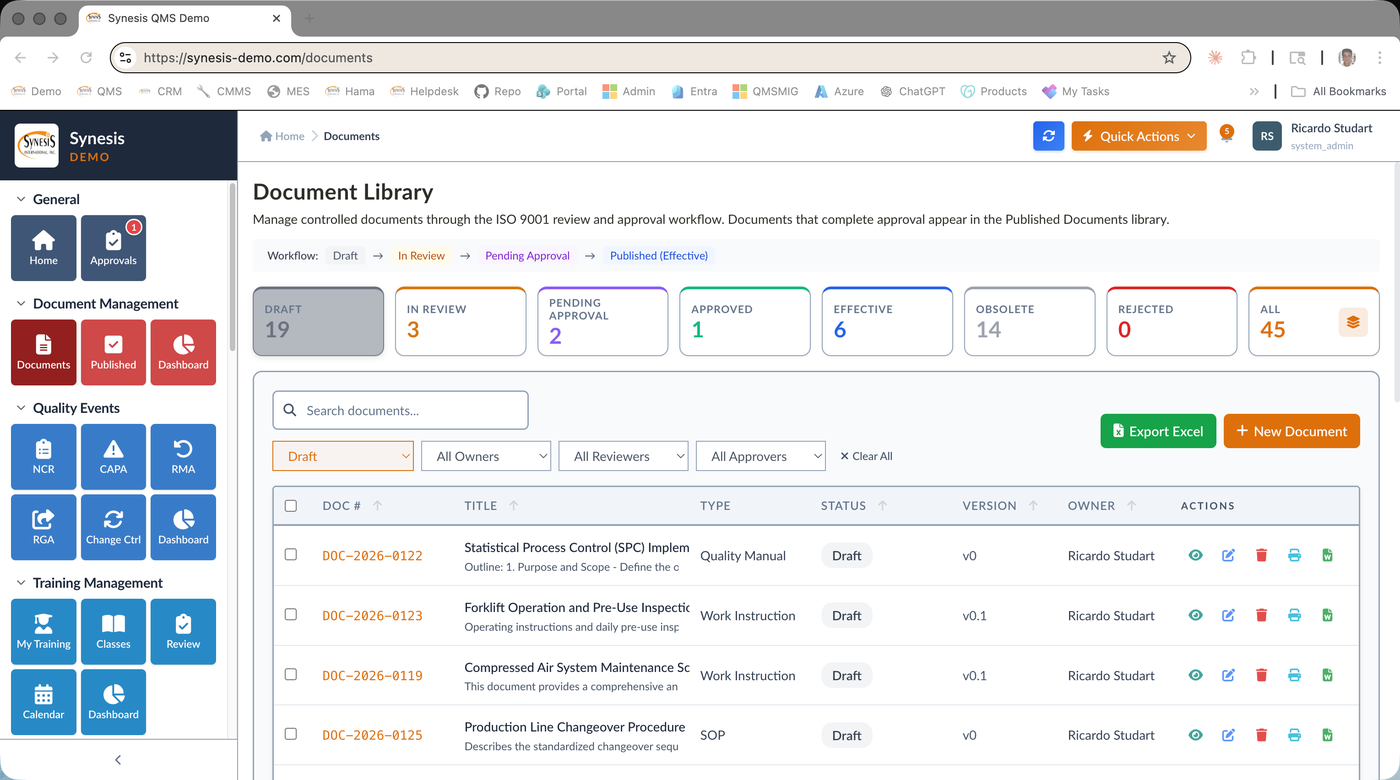
Document control software manages the full lifecycle of controlled documents such as SOPs, work instructions, forms, specifications, and quality manuals. For manufacturers, it enforces the version control, review, approval, and distribution rules required by ISO 9001 Clause 7.5, ensuring everyone works from the current approved revision and that obsolete versions are removed from use. Synesis QMS document control gives manufacturers a single auditable system of record that stands up to customer and registrar audits.
Is the Synesis QMS document control software ISO 9001 compliant?
Yes. The Synesis QMS document control module is built around ISO 9001:2015 requirements for documented information, and it also supports ISO 13485, IATF 16949, and AS9100 environments. It enforces a configurable draft, review, approval, and published workflow with electronic approvals, full version history, and read-and-understand acknowledgments. Every change is captured in a complete audit trail that demonstrates control during an audit.
How does the document control software handle revisions and approvals?
Each document moves through a controlled workflow with an assigned owner, reviewer, and approver. The software automatically increments version numbers, records who approved what and when, and publishes the effective revision to a read-only library while archiving superseded versions. Rejections return the document to the owner with reviewer comments so corrections are tracked rather than lost, giving manufacturers a clean, defensible revision history.
Can the document control software connect to SAP Business One and Microsoft 365?
Yes. Synesis is an SAP Gold Partner and the Synesis QMS platform offers native SAP Business One integration so document control links to the same item, supplier, and order master data used on the shop floor. The platform also works with Microsoft 365, SharePoint, Teams, and Outlook for approvals and notifications, and it can be deployed in the cloud or on-premise. Because controlled documents tie directly to CAPA, audit, and nonconformance records, you get true closed-loop quality traceability.